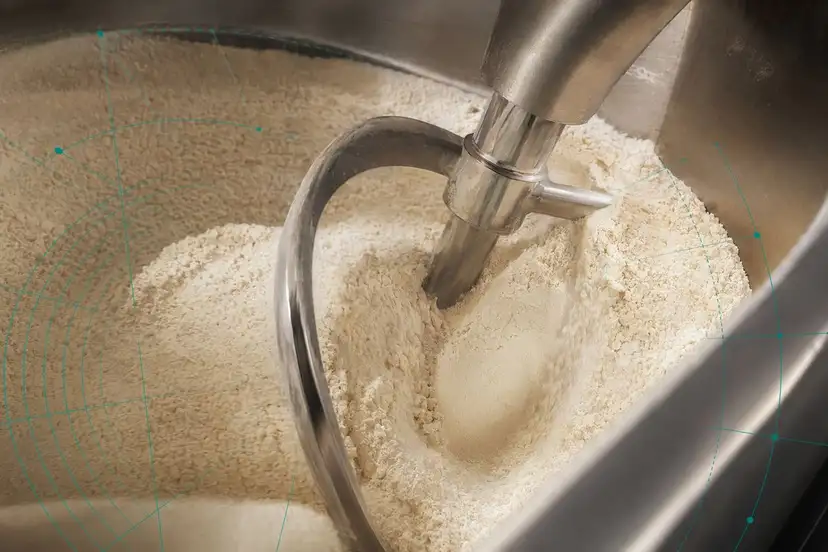
Dry Blending Micro-Ingredients in Bakery Premixes
Practical factory controls for bulk bakery enzymes for premix manufacturers: blending sequence, carriers, segregation risk, humidity, and QA checks.
Request pricing Practical factory controls for bulk bakery enzymes for premix manufacturers: blending sequence, carriers, segregation risk, humidity, and QA checks.
Request pricingFor a bakery premix manufacturer, consistency is built before the customer ever hydrates the mix. Flour base, improvers, enzymes, emulsifiers, minerals, and functional micro-ingredients must arrive in the final bag with predictable distribution, stable flow, and low segregation risk.
This guide covers practical controls for dry blending micro-ingredients, including bulk bakery enzymes for premix manufacturers, without relying on confidential enzyme data or lab-heavy methods. The focus is plant-floor execution: sequence, carriers, humidity, transfer handling, and QA checkpoints that protect batch repeatability.
Micro-ingredients are often low-inclusion components, but their process impact is high. Uneven distribution can show up later as variable dough tolerance, inconsistent proof response, irregular volume, or customer complaints that are difficult to trace back to one production step.
For premix teams, the goal is not just accurate weighing. The goal is controlled delivery through the full route:
A blend that looks uniform at the mixer may still segregate during discharge, pneumatic transfer, vibration, or bag filling. Practical control starts with designing the micro-ingredient system around the factory route, not only around the formula.
A carrier helps low-inclusion ingredients distribute more predictably through a larger premix mass. For bakery premixes, common carrier considerations include compatibility with the flour base, particle behavior, flow, moisture sensitivity, odor neutrality, and label fit.
Use a carrier that supports the finished premix, not just the dosing step:
A carrier that performs well in a bench jar may behave differently in a ribbon blender, tote, or bagging line. Validate under actual handling conditions wherever possible.
For micro-ingredients, direct addition into the main batch can work, but it increases sensitivity to addition point, blender loading, and operator timing. A controlled preblend reduces risk by diluting the micro-ingredients before they enter the full premix mass.
A typical plant-floor approach:
The preblend should be treated as a controlled intermediate, not as loose hand-add material. Label it, close it, stage it clearly, and define the maximum hold condition according to your quality system.
Blending sequence should reduce hot spots and support dispersion. In many bakery premix plants, the base flour or carrier fraction goes in first, followed by preblended micro-ingredients, then remaining major ingredients. The best sequence depends on equipment geometry, fill level, and discharge route.
Avoid uncontrolled changes between shifts. Even when the formula is unchanged, different addition timing or blender loading can create different finished-bag performance.
Segregation risk increases when particles differ in size, density, shape, surface texture, or flow behavior. It can occur during:
Blend uniformity is only useful if it survives the handling route. QA checks should reflect the route the product actually takes.
Bakery premix plants often manage powders that respond differently to ambient moisture. Humidity can affect flow, lumping, caking, and the handling of sensitive micro-ingredients. For enzyme-containing systems, the practical focus is protection from avoidable exposure, not overcomplicated testing.
The weighing room and preblend area deserve the same discipline as the main blender. Many batch issues begin before ingredients reach the primary equipment.
Small additions need a workflow that prevents mistakes. The best systems make the correct action easier than the wrong action.
Avoid relying only on operator memory. A clean, repeatable weighing process protects both formulation intent and customer confidence.
QA should confirm that the blend is fit for packing and likely to remain consistent through transfer. The right checks depend on the product and customer specification, but the practical quality plan should cover identity, weight, dispersion, and handling stability.
Do not place all confidence in a single mixer sample. Sampling location matters. If the product is bagged after a transfer step, include that step in the control plan.
Possible factory causes include uneven micro-ingredient distribution, uncontrolled preblend sequence, humidity exposure, or segregation during packing. Review the batch record, transfer route, and samples from early, middle, and late packing where available.
Check carrier compatibility, sieve condition, preblend time, clump formation, and addition point. Confirm that micro-ingredients were not added as a concentrated charge into a low-motion zone.
Review humidity control, carrier flow behavior, powder compaction, hopper residence time, and fines buildup. Confirm that rework is not changing particle distribution.
Review whether different SKUs, pack sizes, export routes, or storage durations are changing the handling profile. A formula may be stable in one route and vulnerable in another.
When selecting enzyme systems for premix production, technical buyers need more than a product name. They need a fit-for-process recommendation that considers blend route, carrier approach, target dough behavior, customer application, packaging format, and shelf-life expectations.
DoughVector supports formulation managers and purchasing teams with practical guidance for enzyme-containing bakery premixes, including compatibility review, handling recommendations, and quote-ready supply options for industrial premix operations.
For reliable micro-ingredient blending:
The commercial value is straightforward: fewer batch deviations, more consistent customer dough performance, cleaner complaint investigations, and better confidence when scaling bakery premix programs.
Planning a new premix system or reviewing an existing blend route? Request a quote for bulk bakery enzymes for premix manufacturers and include your premix type, target application, packaging format, and current blending setup.
Tell us your application and volume — we reply with pricing and lead time.