Industrial bakery troubleshooting map for premix technical teams
When a bakery customer reports collapsed loaves, tight crumb, sticky dough, poor volume, or early staling, the root cause is rarely a single ingredient. It is usually a chain: flour variation, water absorption, mixing energy, yeast performance, processing time, enzyme balance, and premix dispersion.
For bakery premix manufacturers, the job is to convert that complaint into a controlled formulation adjustment without creating a new failure mode in another plant.
This map is built for formulation managers, technical service teams, and buyers sourcing bulk bakery enzymes for premix manufacturers. It focuses on practical diagnosis: what the symptom usually means, what to check first, and how enzyme systems can be adjusted inside a dry premix format.
Start with the complaint language
Before changing the formula, translate the bakery’s description into a process signal.
| Customer complaint |
What it often means in production |
First technical questions |
| “Loaves collapse after proof or early bake” |
Dough structure cannot hold gas through expansion |
Is proof time longer than normal? Is flour protein lower? Is oxidizing strength reduced? |
| “Crumb is tight or rubbery” |
Poor gas cell expansion, insufficient starch or arabinoxylan modification, or under-fermentation |
Has flour source changed? Is water addition conservative? Is mixing energy lower? |
| “Dough is weak and spreading” |
Gluten network is under-supported or over-relaxed |
Is the line running warmer? Has rest time increased? Is the improver too reducing? |
| “Dough is sticky at makeup” |
Water management issue, damaged starch variation, excessive softening, or humidity pickup in premix |
Is premix flowing cleanly? Has warehouse humidity changed? Is water being added consistently? |
| “Volume is inconsistent batch to batch” |
Premix dispersion, flour variability, yeast stress, or enzyme imbalance |
Is minor ingredient sequencing stable? Are micro-dosed components homogeneously distributed? |
| “Bread firms too fast” |
Starch retrogradation and moisture migration are not being controlled |
Is the product cooling too long? Is packaging delayed? Has sugar or fat changed? |
The safest troubleshooting path is to separate three layers: bakery process, base flour, and premix performance.
Diagnostic layer 1: check the bakery process before reformulating
A premix can only correct what the process allows it to correct. When a complaint arrives, ask for the last five to ten production runs and compare:
- Flour supplier and lot
- Water addition and dough temperature
- Mixer type, mixing time, and energy input
- Floor time, proof time, and proof humidity
- Divider, moulder, and sheeting behavior
- Bake profile and oven loading pattern
- Cooling time before slicing or packing
If the issue appears only on one line, one shift, or one flour delivery, avoid a broad formula change. Use the premix adjustment only after the production signal is stable enough to diagnose.
Diagnostic layer 2: read the dough behavior
Weak dough
Weak dough shows low resistance during makeup, spreads on the belt, and may produce flat shoulders or collapsed sidewalls.
Common causes include:
- Lower gluten strength in the flour
- Higher dough temperature
- Longer bench or proof time
- Excess reducing effect from improver components
- Poor balance between dough-strengthening and dough-relaxing functions
Premix response:
- Review the balance of oxidative support, gluten support, and xylanase-driven dough handling
- Avoid pushing softness too far when the customer’s line has long fermentation or high mechanical stress
- Confirm that minor components are evenly distributed in the blender, especially when inclusion levels are low
Sticky dough
Sticky dough is not always a sign of too much water. It can come from water release during processing, flour damage variation, enzyme imbalance, or premix humidity pickup.
Common causes include:
- Higher damaged starch flour
- Increased ambient humidity
- Water addition based on outdated absorption data
- Over-softening of the dough system
- Poor premix flow causing localized concentration of functional ingredients
Premix response:
- Recheck anti-caking and carrier selection for micro ingredients
- Tighten dispersion of enzyme components across the premix batch
- Adjust the enzyme system toward controlled extensibility rather than aggressive softening
- Confirm packaging moisture barrier and warehouse handling conditions
Tight crumb
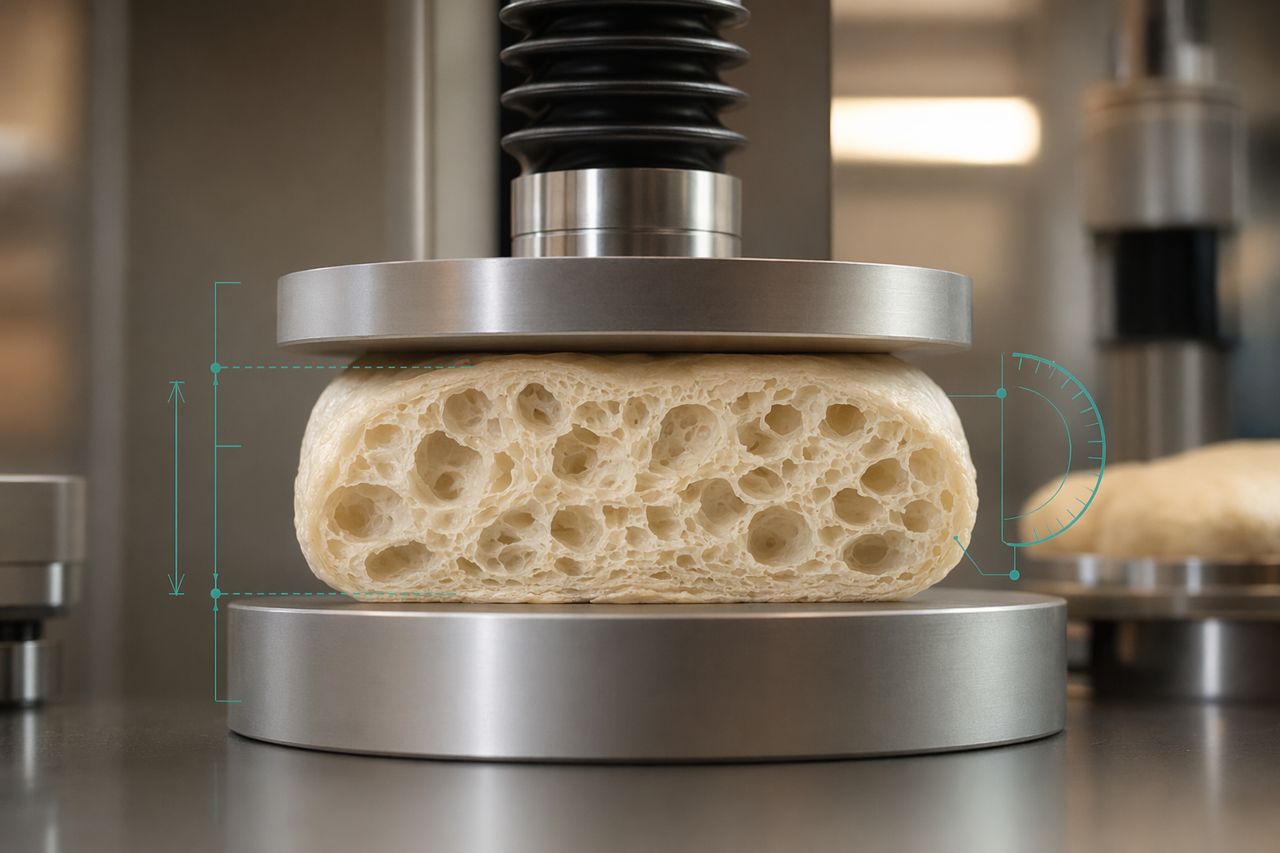
A tight crumb points to limited gas cell expansion or weak gas retention at the wrong stage.
Common causes include:
- Underdeveloped dough
- Low fermentation activity
- Flour with lower extensibility
- Insufficient modification of non-starch polysaccharides
- Formula not matched to high-speed processing
Premix response:
- Review xylanase balance for dough machinability and gas cell expansion
- Check amylase support for fermentation and early bake expansion
- Ensure the premix does not create excessive resistance on fast makeup lines
Diagnostic layer 3: connect finished bread defects to enzyme balance
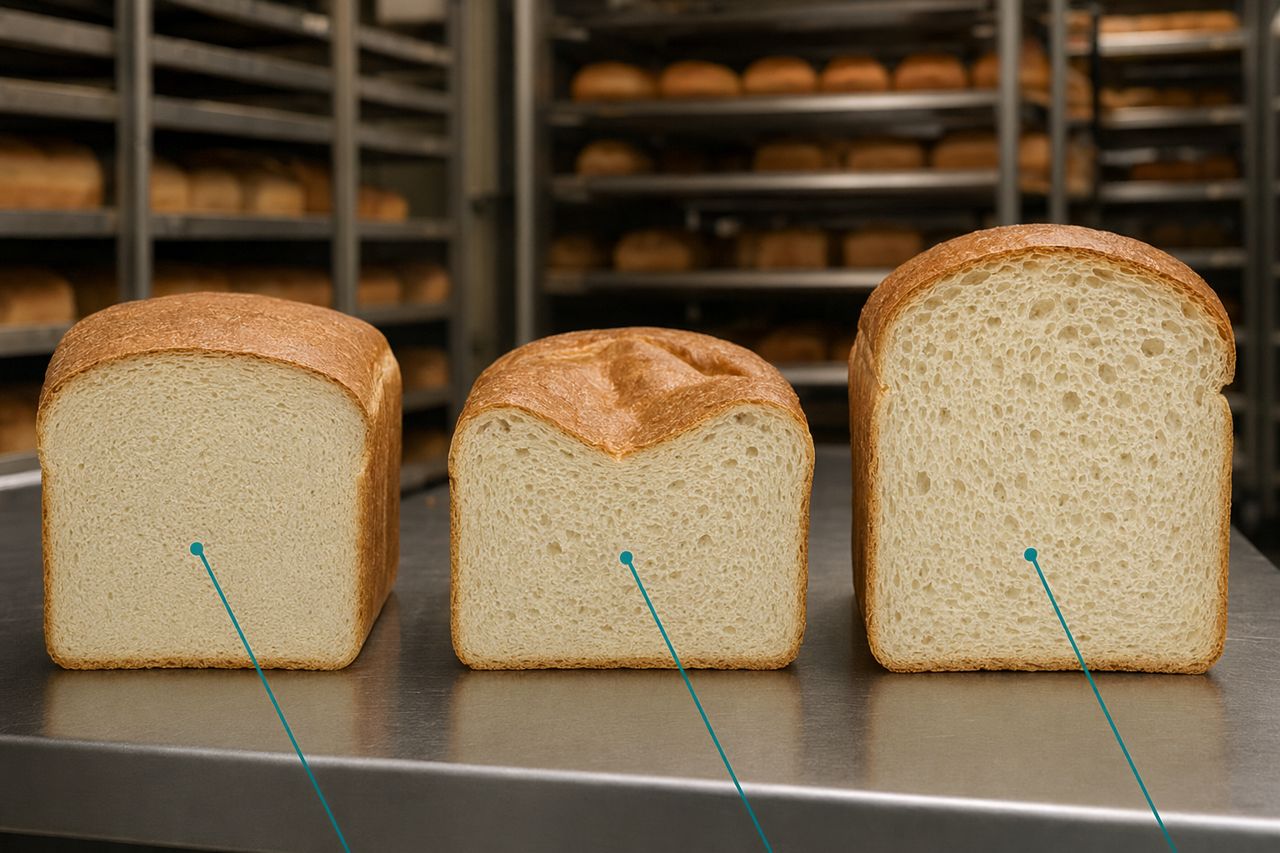
Collapsed loaves
Collapsed loaves usually indicate that gas production, gas retention, and setting time are out of balance.
Check first:
- Overproofing or proof box variation
- Flour strength decline
- Oven spring followed by structural failure
- Dough too warm or too slack
- Improver system too soft for the line
Potential premix direction:
- Strengthen gas retention before increasing fermentable sugar release
- Keep dough tolerance in focus, not only volume
- Validate on the customer’s process window, not only a controlled bench bake
Poor volume
Poor volume can come from weak fermentation, low extensibility, poor gas retention, or insufficient oven spring.
Check first:
- Yeast quality and storage
- Water temperature and dough temperature
- Mixer performance and dough development
- Flour absorption and protein quality
- Divider and moulder stress
Potential premix direction:
- Balance amylase support with dough structure
- Use xylanase selection to improve expansion without creating stickiness
- Consider lipase-based strengthening where crumb structure and tolerance need improvement
Shelf-life complaints
Shelf-life complaints are often reported as “dry,” “firm,” “crumbly,” or “not fresh after day two.” Technical teams should separate moisture loss from starch firming.
Check first:
- Cooling time before packing
- Packaging integrity
- Bake loss
- Formula changes in fat, sugar, emulsifier, or fiber
- Distribution temperature
Potential premix direction:
- Use anti-staling enzyme systems to slow crumb firming
- Balance softness with sliceability and resilience
- Avoid over-softening if the customer needs clean slicing at high speed
Premix manufacturing variables that change bakery outcomes
A technically correct enzyme system can still underperform if the premix is not built for industrial handling.
1. Blend uniformity
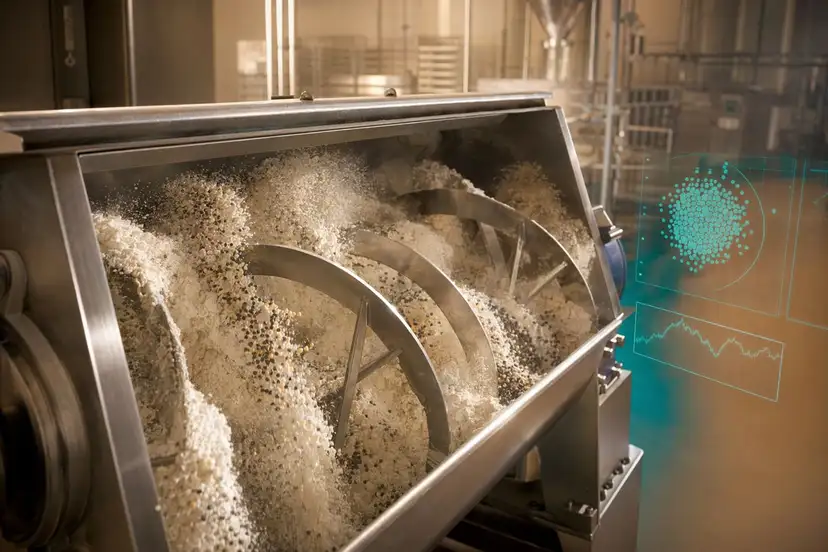
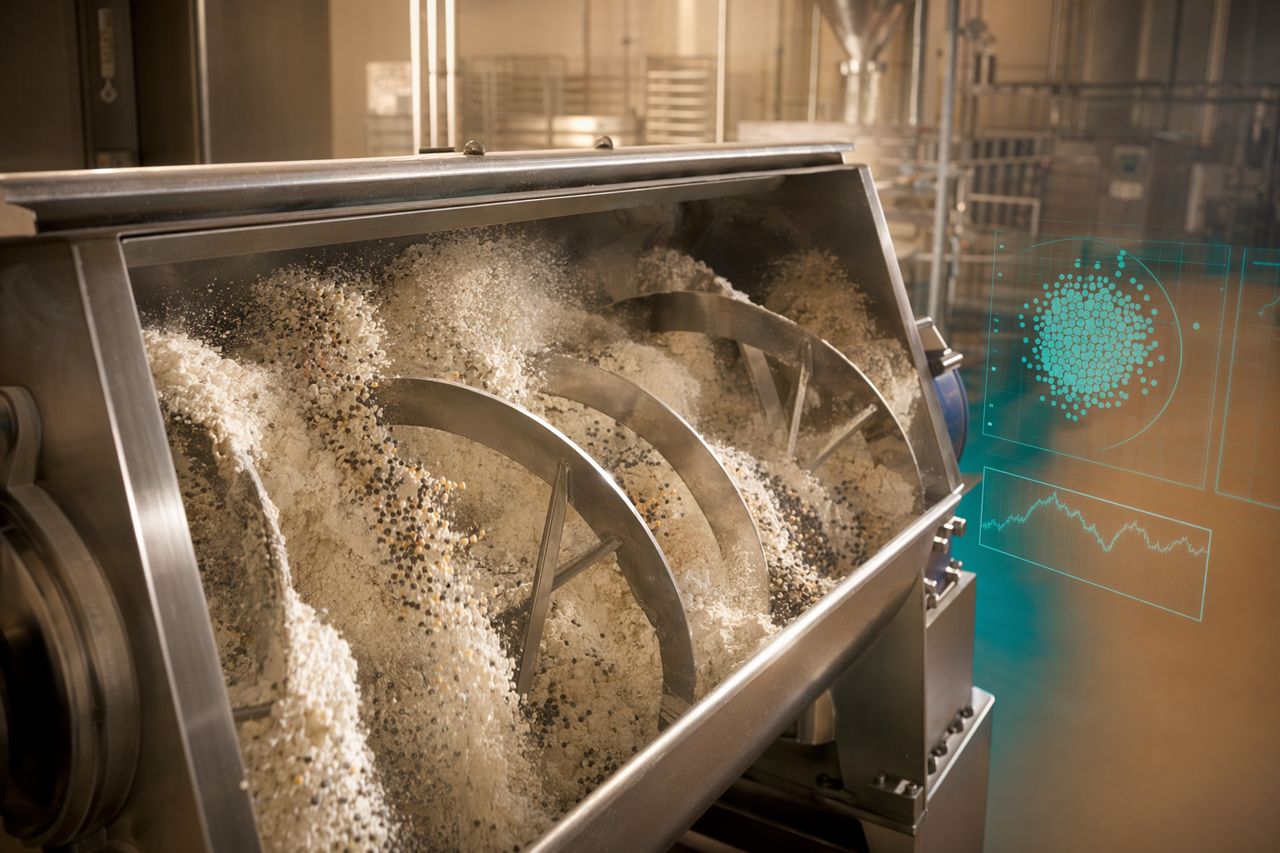
Low-inclusion functional ingredients need reliable distribution. Validate blender loading order, carrier compatibility, and discharge behavior. Segregation during transfer can show up as batch-to-batch loaf variation at the bakery.
2. Carrier and particle match
A carrier that is too coarse, too fine, too dense, or too hygroscopic can create dosing drift. Match particle behavior to flour flow, blender residence, and the customer’s dosing equipment.
3. Moisture control
Premix humidity pickup changes flow and can affect performance consistency. Review packaging, pallet storage, and open-bag handling, especially for customers in warm or humid plants.
4. Thermal and mechanical exposure
Enzyme stability is influenced by storage, transport, and processing stress. For premix manufacturers, the practical goal is not maximum theoretical potency; it is predictable performance through the customer’s real production window.
5. Formula interaction
Enzymes do not work alone. Oxidants, reductants, emulsifiers, fibers, salts, sugars, fats, and acids all influence the final dough system. A small change in one component can shift the enzyme response.
Troubleshooting sequence for technical teams
Use this order before requesting a reformulation:
-
Confirm the defect pattern
One batch, one shift, one line, one flour lot, or all production?
-
Capture process conditions
Water, temperature, mixing, proofing, baking, cooling, and packing.
-
Review flour and formula changes
Protein quality, absorption, damaged starch, ash, fiber, sugar, fat, and improver changes.
-
Check premix handling
Lot age, storage, bag closure, flow, dosing accuracy, and mixing into flour.
-
Map the symptom to the dough stage
Mixing, makeup, proof, oven spring, cooling, slicing, or packed shelf life.
-
Adjust the enzyme system with one target at a time
Volume, tolerance, crumb openness, softness, or processing stability.
-
Validate across the process window
Run the solution under normal, short, and extended processing conditions where possible.
Where DoughVector fits
DoughVector supplies enzyme systems designed for bakery premix manufacturers that need consistent performance in dry blends, bulk sourcing programs, and multi-customer product platforms.
Our work is formulation-led:
- Dough tolerance for industrial lines
- Volume and crumb structure support
- Shelf-life and softness systems
- Sticky dough and machinability correction
- Premix-compatible carrier and dispersion planning
- Technical support for customer complaint diagnosis
We help premix teams move from symptom to controlled adjustment without overcorrecting the formula.
Embedded explainer video
A short faceless explainer on this page shows the troubleshooting flow from premix blending to dough behavior to finished bread diagnostics. It is designed for technical buyers who need a quick visual reference before opening a formulation discussion.
Request a quote
If you manufacture bakery premixes and need bulk enzyme systems for loaf volume, dough tolerance, crumb quality, or shelf-life performance, send your application details through the on-site form.
Include your product type, target claim, processing constraints, and current defect pattern. DoughVector will respond with a practical supply and formulation discussion.
Request a quote